
Defense Training and Coalition Readiness

DEFENSE TRAINING + COALITION READINESS
FEBRUARY 2026 || JUSTIFIED ACCORD
KENYA, DIJBOUTI, TANZANIA
Led by U.S. Army Southern European Task Force, Africa (SETAF-AF) under U.S. Africa Command, the exercise integrated approximately 1,500 personnel from more than 15 nations against a training design that spanned live-fire events, command post exercises, defensive cyber operations, and emerging technology validation. JA26 was built explicitly to test multinational interoperability and to validate new systems in austere operating environments.
Parabellum Aerospace was on the ground in a volunteer capacity, providing UAS instruction and live demonstration support to soldiers of the 1st Battalion, 181st Infantry Regiment, Massachusetts Army National Guard — a unit with a decade-long State Partnership with Kenya Defense Forces through the National Guard Bureau’s State Partnership Program. No contract. No invoice. A deliberate decision to put expertise where it was needed. Effective coalition UAS training requires more than hardware; it requires a shared operator language.
CONSISTENT SKILL GAPS
Coalition exercises consistently surface the same readiness gap. UAS employment has become a baseline tactical requirement across echelons, but foundational competency — the ability to build, configure, plan, fly, and sustain a small unmanned system — remains inconsistently distributed across partner nation forces. An operator who can fly a system handed to them is not the same as an operator who understands what they are flying and why it is configured the way it is.
Parabellum’s instruction at JA26 was structured around a deliberate three-phase arc: educate, equip, and demonstrate. Training began with a capabilities brief to unit leadership and selected personnel — covering system specifications, tactical employment concepts, and the role FPV platforms play in reconnaissance and force protection. From the brief, instruction moved to a hands-on workshop with approximately ten soldiers drawn from the battalion. Platform familiarization, pre-flight procedures, manual flight controls, and situational awareness in flight. Instructors worked directly with each operator to build confidence and functional competence within a compressed timeline.
WHAT COALITION TRAINING ENVIRONMENTS SURFACE
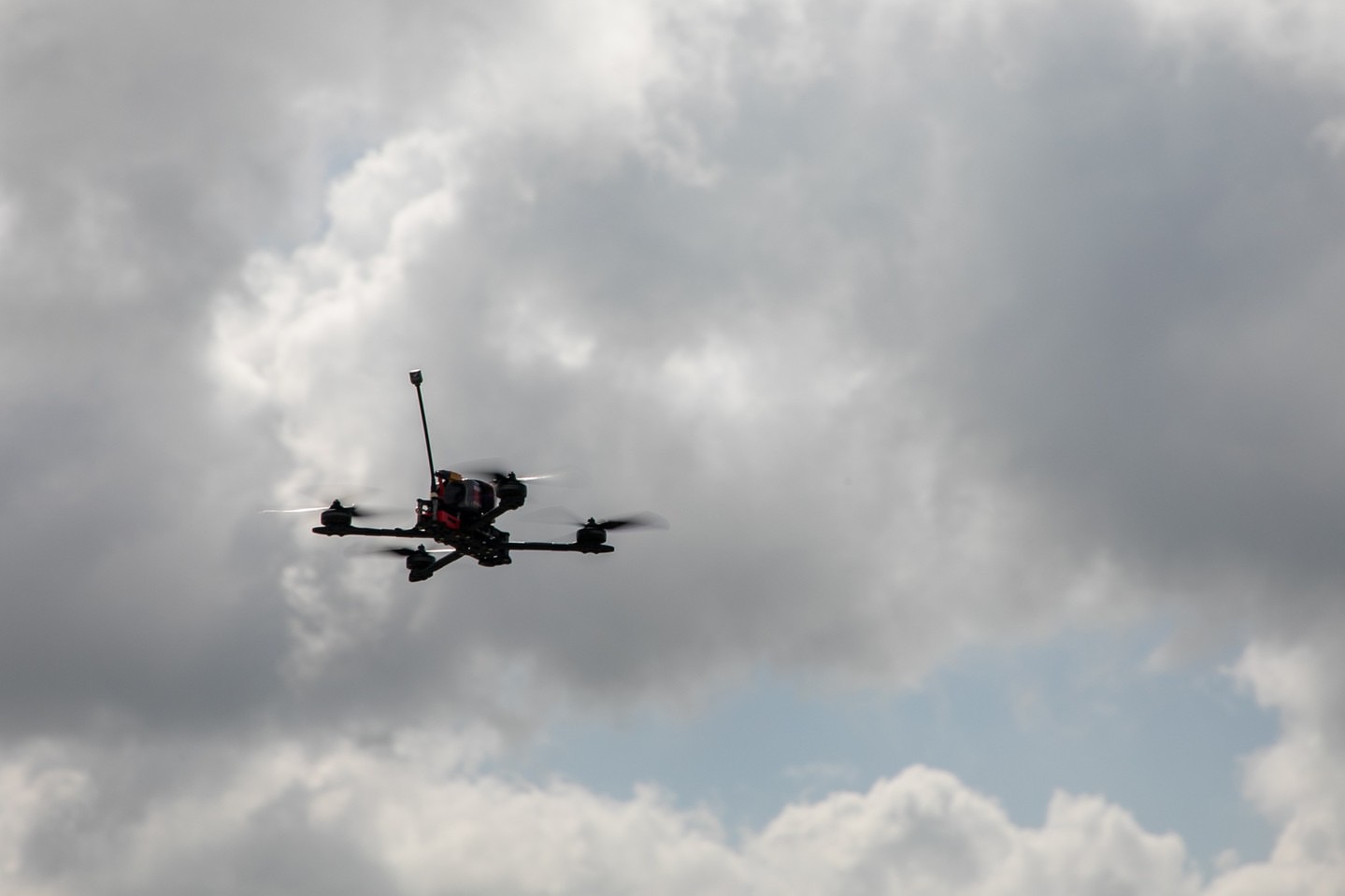
The training arc culminated on the exercise’s Distinguished Visitor Day, where Parabellum’s team delivered a full live flight demonstration for senior leaders and coalition observers. The demonstration covered the tactical range of FPV employment: ISR passes and aerial reconnaissance, precision maneuvering showcasing platform control, and a live simulated strike run. Decision-makers at the formation and coalition level observed what these systems do in trained hands; not through a capability brief, but through direct observation.
This is where coalition training environments produce requirements that standard acquisition briefs do not anticipate. Once operators are exposed to what small UAS platforms can do across mission sets — ISR, force protection, kinetic support — the demand signal expands. Exercises like JA26 function as validation environments precisely because austere conditions and multinational friction expose capability gaps that controlled demonstrations do not.
REQUIRING SHARED OPERATOR LANGUAGE
Platform-level interoperability requires more than hardware compatibility. It requires shared operator language: standardized employment concepts, common maintenance practices, and training transferable across units regardless of home nation doctrine. Instruction designed for a single unit’s specific workflow does not produce coalition-level competency.
Sustainment-focused instruction, scenario-driven repetitions, and troubleshooting under realistic conditions are not supplemental curriculum. They are the functional difference between a unit that can employ UAS and a unit that can sustain employment through a rotation. The Massachusetts National Guard soldiers who participated in the JA26 workshop left with hands-on reps, not just classroom exposure — that distinction matters in terms of actual readiness.
TRAINING AS A PROCUREMENT DECISION
The JA26 model makes explicit what acquisition offices sometimes underweight: the platform investment and the training investment are not separable decisions. A unit that acquires a capable system without the training infrastructure to sustain operator proficiency has not closed a capability gap. It has created a sustainment problem.
Parabellum Aerospace designs training into the acquisition from the start. Mission-specific training packages, 24/7 white-glove support, and curriculum built around real operator workflows rather than platform demonstrations are standard components of every Parabellum engagement. The Innovation Lab in Spring Lake, NC — twenty minutes from Fort Liberty — keeps development and training within reach of the operators who generate the requirements.
Parabellum’s participation in Justified Accord 2026 was entirely pro bono. The decision to support that mission reflects the same posture that built this company: when there is a capability gap and the team can help close it, they show up. The work comes first.