
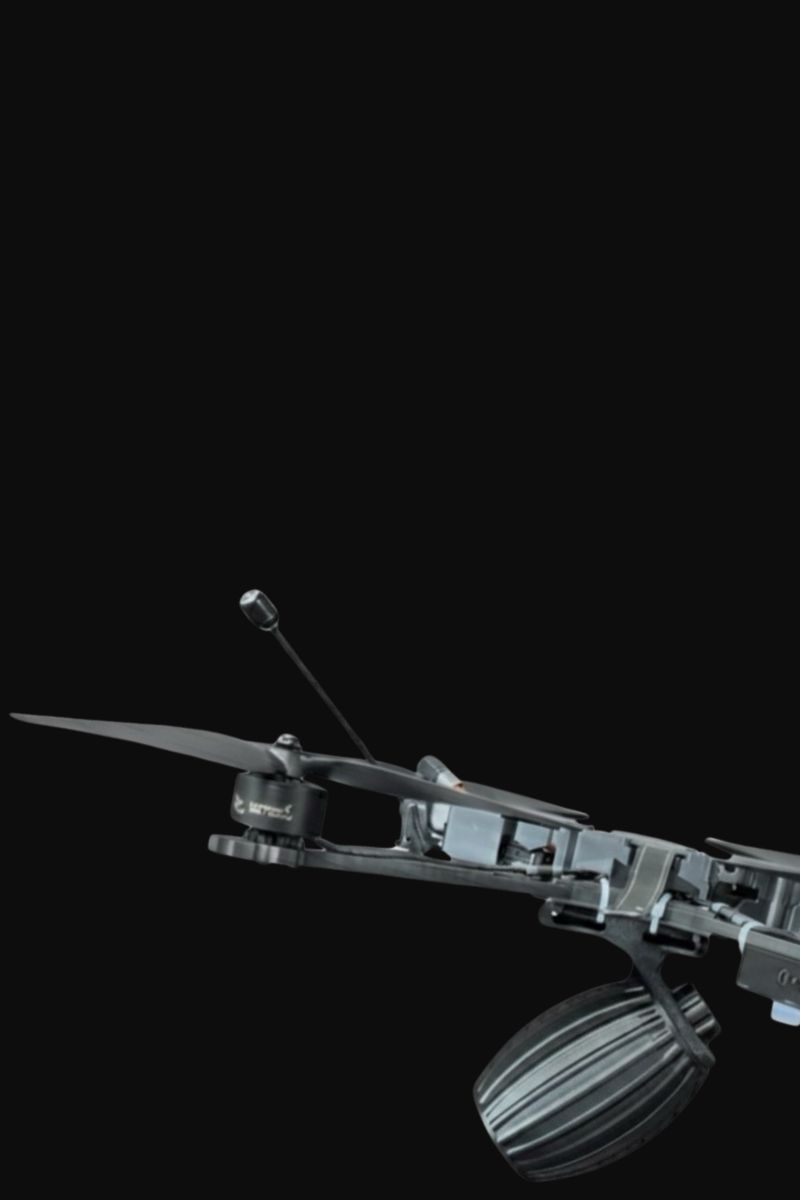
Integrating Commercial Drones into Military Operations

Integrating Commercial Drones into Military Operations: The Convergence Nobody Planned For
DEFENSE INNOVATION | MAY 2026
The U.S. military did not plan to become dependent on commercial unmanned systems. It happened because the battlefield moved faster than the traditional acquisition cycle. From early ISR missions employing off-the-shelf quadcopters to the large-scale FPV drone employment observed in modern contested environments, the operational utility of commercial UAS platforms proved itself under fire before doctrine could catch up.
Today, military units across the force are actively evaluating commercial and near-commercial UAS solutions to fill capability gaps that legacy programs cannot address on operational timelines. The demand is real. The challenge now is selecting solutions that meet the readiness, compliance, and mission requirements that serious operational environments demand.
A Brief Timeline of the Shift
The inflection point for commercial UAS in military application did not arrive overnight. Early adoption was informal. Units with initiative and budget latitude sourced commercially available platforms to supplement organic ISR capability. Results were mixed. Systems designed for consumer or industrial use struggled with EMS-contested environments, lacked secure data links, and offered no meaningful sustainment path. The lesson was clear: commercial availability is not the same as military suitability.
The next phase brought more deliberate integration. Programs like the Defense Innovation Unit’s Blue UAS framework formalized a pathway for vetted, NDAA-aligned commercial platforms to reach military end users through a structured compliance and security review process. The market responded. A generation of defense-focused UAS manufacturers emerged to occupy the space between consumer-grade commercial platforms and the cost and timeline constraints of major defense programs. That is the space Parabellum Aerospace was built to operate in.
Key Advantages: Affordability, Adaptability, Modular Architecture
What makes commercial and near-commercial platforms attractive to military buyers revolves around the speed of iteration. A major defense program that takes years to field cannot respond to a battlefield requirement that emerged last quarter. A manufacturer with a direct relationship to operators, rapid prototyping capabilities, and open-standard architecture can.
Parabellum Aerospace’s platforms are built on open-standard designs using COTS components. This operator-forward design enables rapid iteration to accommodate evolving battlefield conditions. Modular payload bays across both OrdTech platforms (The Abaddon and The Apollyon platforms), allow units to configure for ISR, electronic warfare, communications relay, or kinetic employment without swapping airframes. That adaptability is an operational requirement for attritable systems in contested environments.
- NDAA-aligned systems available for compliance-restricted acquisitions
- Modular payload architecture supporting ISR, EW, comms relay, and kinetic roles
- Open-standard, COTS-component builds enabling fast iteration on operational timelines
- Mission-specific training and 24/7 white-glove sustainment support included
Lessons Learned from Live Training Environments
Parabellum’s platforms have been employed in live training environments alongside military assets. Parabellum Aerospace has identified a common decision-factor; operator functionality and workload.
A platform that requires a dedicated pilot, a separate sensor operator, and a third person to manage the data link will not survive real rotation cycles. Systems that reduce workload through guided flight modes, autonomous loitering, and simplified interfaces sustain employment rates. The Apollyon platform was designed with this directly in mind. Autonomy-assisted flight reduces the cognitive load on the operator without removing human judgment from the employment decision. The Abaddon’s fiber-optic guidance architecture removes the RF dependency that has proven to be a critical vulnerability in contested and underground environments. Engineering implementation backed by operator experiences and feedback.
The Future: Bridging Commercial Technology and Battlefield Needs
The Department of Defense’s $1.1 billion Drone Dominance Program has made one thing clear — the demand signal for NDAA-aligned, domestically produced sUAS is no longer emerging. It is here. The companies that will supply the force over the next decade are not necessarily the ones with the largest programs. They are the ones with the fastest iteration cycles, the deepest operator relationships, and the clearest compliance posture.
Parabellum Aerospace is uniquely positioned at that intersection. As a SOF-veteran-owned operation supporting U.S.-made innovation, Parabellum Aerospace aligned with NDAA-compliance standards for optimal integration. The gap between what units need and what the market offers is closing. Parabellum is part of that solution.
For mission, partnership, or procurement inquiries: [email protected] | www.parabellumaero.com
PARABELLUM AEROSPACE | DIVISION OF WOLFPACK STRATEGIC SOLUTIONS |
SPRING LAKE, NC | CAGE CODE: 17Z41